Tuesday, May 18, 2010

Summer Workshops for 2010

This July we are proud to offer 2 great workshops; on July 20-22, Author & Senior Furniture Conservator, Donald C. Williams, will be here talking about & demonstrating Restoration of Veneers and Their Finishes. This intensely hands-on workshop will focus on the nature and technology of veneer-work and restoring damaged veneered surfaces, including a range of applications from the laying of new veneers to re-integrating aged and damaged veneers, and replicating veneer and marquetry surfaces. Special emphasis will be on the selection and making of veneers, and in finishing them in a manner most compatible with the existing surrounding surfaces. This course also integrates adhesive technology as a critical component in the problem solving process.

Then, on July 26-30, National Institute Of Wood Finishing instructor, Mitch Kohanek, will be teaching a 5-day course on Finishing New Wood. This comprehensive wood finishing class will educate you to know how and why you finish wood. Students will keep all of the panels they create. Sessions include: The proper preparation of wood, methods of using dyes, stain, glazes and toners to color wood. Understanding why and how to apply oils, shellac, lacquer, varnish, urethane and water base coatings using rags, brushes and spraying equipment. How to create the desired sheen and maintain that sheen will also be covered. Problem solving and repairing finishing defects such as blotching, orange peel and fish eye will be explained.


If you'd like more information on these workshops, please visit: http://www.woodfinishing.org/workshops.htm
Seats are still available for both courses.

Friday, May 14, 2010

Rights of Passage - Another year ended...


Today was the last day of classes, the graduation ceremony is next Monday (5/17/2010). Just like the classes that have passed through these doors since 1988, the graduating class of 2010 got up on a ladder for the "signing of the tube".

The Dust collection tube that runs through the workshop has been part of a tradition at DCTC, where the students leave their mark on the school, just as the school has left it's mark on them. Each year the students paint, decorate, veneer, faux finish, or install something from their class. This year, the class of 2010 had a group photo taken, enlarged and framed in a frame that they gilded and painted the NIWF logo and 2010 in reverse on the glass.
Good luck to all the grads of 2010. They have worked very hard, and we hope that as they go out into the world, they will always keep in touch and visit the school when they can, to help pass along their knowledge to the current students in the upcoming years.

Thursday, May 6, 2010

Wood 1021 Wood Refinishing: More Before & After Pictures

We are wrapping up really fast, and a lot of great furniture is being turned out by the students. I just wanted to share some more of the work.

This bamboo chair came it in rough shape, as you can see! But some great work and a little shellac, and we've got a beautiful little side chair.
Here is a picture of a Mission Library Table that had an ink spill on the top. With a little artistry and skill, the ink stain has been removed from sight. a little shellac and some spot repair, and this table is set for another 100 years.

Thursday, April 29, 2010

Wood 1021 Wood Refinishing: Before & After Pictures

Students are in their final section of the 9 month course, Refinishing. Here we take furniture, strip it down to the bare bones, and start over. We involve our knowledge of methods of fastening as we need to re-glue many items before they can be stripped. We may use some of our wood shop skills if we need to replace missing wooden components. We may need some spot repair skills to fix nicks, dents and scratches, or to in-paint on filler. We use our knowledge of solvents to devise a game plan for how we are going to strip the furniture. We make educated choices about coatings taking into consideration both the needs of the object, and the needs of the user. Then we make it happen by stripping, coloring and coating the furniture. Here are 2 examples of before & after results that our students are turning out every day!


A Maple Rocking Chair Before... And After!


A Mission Style Plant Stand Before... And After!

Tuesday, March 30, 2010

Wood 1010 Wood and Finishing Technology: Larry Van Isagam from Van Technology visits NIWF

We were very fortunate today to have Larry Van Isagam, President and founder of Van Technology, come and spent the day with us to talk about water based coatings. Larry and the students had a great conversation about water base,
which is an ever increasing part of the wood coatings industry.
The students had some great questions regarding their experiences
with the coatings, and Larry was very helpful in explaining how they work, and why we might choose to use a water based coating.
He also demonstrated a few of his products and allowed the students to use them and get some
more 1st hand knowledge of the coating and see what they are all about.
A Big thanks to Larry, who has always been a friend to the program here at DCTC!


Friday, March 26, 2010

wood 1032 Furniture Conservation: Don Williams and The MN Woodworkers Guild meet at DCTC


Don Williams came in from Washington D.C. yesterday and today to work with the students, as well as co-sponsor of his visit, The MN Woodworkers Guild. Yesterday he & the Students had an in depth conversation about color matching & color theory, Molecular Thermodynamics, solubility parameters of coatings, and what ever else the students wanted to know about.


Today was a more hands-on day. The Guild members joined the students to watch Don demonstrate several different methods of mold making and duplication for use in repairing wooden items such as picture frames and carvings that may be missing or damaged, and to learn about gold leafing or gilding.


Don demonstrated a number of materials that can be used to make and cast molds, and he demonstrated both water and oil gilding. In addition, there was some great back and forth about hide glue, shellac, Japanese Lacquer, and general conservation techniques Don uses in his day to day work as a Museum Conservator.


We always like to have Don in to work with the students, and we can't wait until his next visit this summer for his 3-day workshop on the restoration of veneers and their finishes. (July 20-22, visit http://www.woodfinishing.org/workshops.htm for more info on summer courses)

Wednesday, March 24, 2010

Students return to Fort Snelling for more conservation work

We took another field trip to the Fort Snelling Chapel today, where the students could see how their work held up since their last visit (very well, I might add!) and get back to work on this historic building.
Today we looked at some solvent testing, went through all the steps we've learned in school and developed a cleaning and re-coating schedule, then followed through on it!
All the students felt confident taking on new challenges in a real-life setting.


Thursday, January 28, 2010

Wood 1010 Wood and Finishing Technology: Sample Boards

In our 1st class back from winter break, we hit the ground running! The students have studied our 2 main text books, and we do some intense lecturing about solvents, coloring agents and coatings, as well as different means and methods of applying these things. Then we put this knowledge into action by finishing 10 different boards with 10 different finishing schedules.

We spray and brush lacquer, spray, brush and pad shellac, we brush varnish, we shoot gloss & satin, we do open pored finished, and closed pore "piano" finishes. We color strike pores, we stain, dye, glaze, distress, tone and shade. and we dabble a bit with water base finishes as well.

This intensive 3 week section is full of learning, and getting to experience what tools we have as finishers and what their benefits and challenges are.

Monday, November 23, 2009

Wood 1007 Methods of Fastening: Day One

Today we begin another new section; Methods of Fastening. In this section we look at and learn about the many ways that furniture is fastened, as well as how to repair the best, and the worst of joints. We will be re-gluing chairs and tables, and making any replacement parts we might need along the way using the skills we acquired in our woodworking section.


We started the day with some conversation on why glue joints fail. There are many reasons that glue joints can fail and it only takes one misstep to make even the nicest looking joint come loose. However, we often find that there is at least one, if not many things wrong with some joints, and we need to learn how to respond to these situations. Our 1st step is learning about how our furniture is constructed.


The students brought in many of their own projects, but we also have some pieces that need attention here in our workshop. We need to know how furniture is put together in order to know how it is taken apart, so we need to look at each chair individually to check for nails, screws and other fasteners, we look at where the joints are and number them so we can put the chair back the way it was. Then we get down to the nitty gritty and actually begin dis-assembling the furniture, and clean the joints, make any necessary repairs in preparation to re-glue each chair.

Thursday, November 19, 2009

Wood 1004 Wood Working: Veneer Patching

As we wind down the woodworking section, we have looked at power tools and hand tools, we have learned how to square a board, we have done riping and cross-cutting on the table saw, made tenons on the router table, used the scroll saw to duplicate a back splat for a chair, we've hand cut tenons, made usable cutting boards and now we are looking at veneer patching.


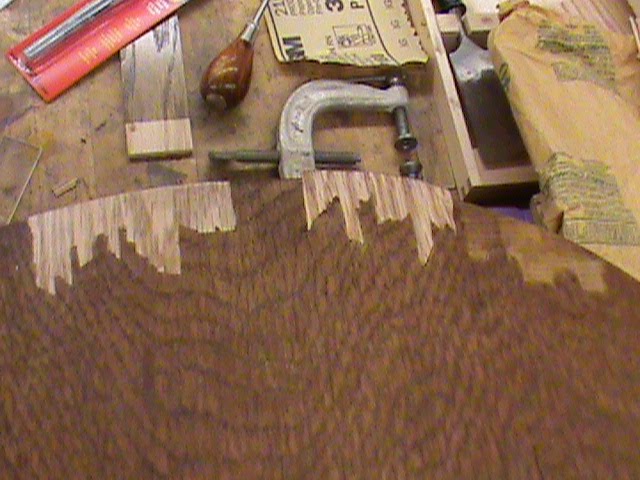
There are a number of ways to patch veneer, in Spot Repair I, we learned how to do burn-in's, in Spot Repair II we learned that we could do a polyester fill, now we look at replacing wood with wood. This gives us our grain and texture back, if the piece should ever be stripped, there will be wood there, and it gives us another tool we can use to solve problems. Even within the veneer patch, there are a few different techniques, you could cut a uniform shape into the veneer and replace the missing piece with a new piece of veneer, scarfing the joint to feather in the new wood. If you have the piece of veneer that came off you can re-glue it. You can also cut your new veneer with a jewelers saw and fit it into the existing gap, while not loosing any original wood or finish. Once you have put all the new pieces in, it is a matter of an accurate color match and top coat and you can have a very nice repair on any veneered surface.

Wednesday, November 4, 2009

Wood 1004 Woodworking: Begining a New Chapter Again


We are 3 days into our next section of our program, we set color aside for a bit and turn our focus to woodworking. Our students come to us with a variety of backgrounds, some have never worked with wood, some have hand tool experience and no power tool experience, or vise-versa, and some have been woodworkers, professional or hobbyists for many years. With this mixed bag, it is important to cover all the basis, and look at safe practices and proper technique.

In the wood working section we learn techniques required to make wooden components for repairing wooden objects. We learn how to square a board, make, and repair a number of different common joints used in woodworking, and the proper technique for sharpening hand tools and the safe practices of using any of our tools.

Although wood working is not the primary focus of our training at NIWF, it is a useful skill to be able to make replacement parts for wooden furniture, millwork, or any other wooden objects.

Thursday, October 29, 2009

Wood 1019 Spot Repair II: NIWF Tours Schneiderman's Distribution Center

On a week packed with field trips, we visited Schneiderman's Furniture Distribution Center. Our guide was past NIWF Graduate Kathy Morse, who works at Schneiderman's ensuring the quality of the furniture meets the Schneiderman's standard. We saw how they do touch-up and repair on some of the furniture that comes in that might not meet their standards, or on returned furniture that had been damaged. After a few demonstrations Kathy also let the students perform some of the repairs as well.

Once again, the class got to see a past grad in action at their work place, using their skills and knowledge that they gained while attending DCTC & NIWF.

Wednesday, October 28, 2009

Wood 1019 Spot Repair II: Class of 2010 visits HOM Furniture

Once again, NIWF Students got to take a behind the scenes tour of HOM Furniture's Distribution Center. And like in years past, they got to work side by side with the Techs at HOM doing spot repair, upholstery repair, leather & vinyl touch up, wood fills, burn-ins and many other techniques the students already learned.


Working out in the real world gives the students a first hand view of what they might face on a day to day basis once they leave DCTC. Some of the Employees at HOM are past graduates of the program so they speak the same language of wood finishing. This unique experience helps to shape the students knowledge of some of the careers that may be opening up to them as graduates of the National Institute of Wood Finishing.

Tuesday, October 27, 2009

Wood 1019 Spot Repair II: NIWF Does Conservation Work at Historic Fort Snelling Chapel

On our 1st of many field trips, the students got to roll up their sleeves and put to good use the knowledge they have already acquired. The Fort Snelling Veterans Memorial Chapel, built in 1927. Fort Snelling was deactivated as a military post in 1947, leaving the chapel sitting unused until it narrowly escaped a scheduled demolition for the highway system in the mid 60's. It is alive and well today serving many facets of the state's population through such programs as: weekend open houses for tourists to the historic Fort Snelling; rehearsals and weddings of all faith groups; funerals of all denominations; general community meetings; and weekly Sunday non-denominational services.


Our goals were to clean and conserve the pews, kneelers and surrounding wood. Each student dug in with a few pews each, using mild cleaning solution, replacing worn finish where needed, spot repair as needed, and finally padding shellac to give an authentic, original look, feel and lustre to that well worn interior.


We were guided by past NIWF grad, Travis Beard, who volunteers on the Fort Snelling Memorial Chapel Foundation, and has been working in the chapel for a while, cleaning and restoring the woodwork, carvings and wooden statues.

Monday, October 26, 2009

Another Testimonial From a Past Grad


Gerald Cartwright Graduated in 1998. He currently lives and works in Harrison, AR, where he runs his own finishing shop - Cartwright Wood Finishing Company


"In May of 1997, I attended a woodworking trade show in Little Rock, AR. It was through this show that I made a chance contact with a former graduate of the DCTC Wood Finishing Technology Program. The successful graduate explained the course work, skill sets learned, and the joy of knowing how to repair furniture. From this meeting, I was inspired to contact Mitch Kohanek at DCTC.
I graduated the Wood Finishing Technology Program at DCTC in June of 1998.
After graduating from the Wood Finishing Technology Program at DCTC, I was employed with a high end commercial furniture dealer in the Twin Cities area. My position was Manager, Restoration Services. I was tasked with starting a furniture service department at this company. Upon the completion of 2.5 years of employment, I was given the opportunity to purchase all of the assets of the service department and provide service through a sub-contractor arrangement.
In mid 2001, I relocated back to north central Arkansas, the area where I was raised. I started a furniture services company in Harrison, AR. My services include furniture refinishing, pre-finishing, and furniture touch-up, serving both commercial and residential customers.
The skill sets I learned at DCTC from Mitch Kohanek has allowed me to repair and finish anything with great confidence. All of the technical skills learned at DCTC Wood Finishing Technology Program are applied in my current business.
Mitch Kohanek is an inspiring teacher who can communicate his skills to those who care to learn."

Thursday, October 22, 2009

Wood 1019 Spot Repair II: Joe Renchin Spends the Day Talking Upholstery


NIWF Advisory Board Member and Master Upholsterer, Joe Renchin Came in today for another great demonstration on upholstery. Joe has spent 35 years in the business and he is always happy to share his expertise with the students at NIWF. He spoke extensively about the business of upholstery and demonstrated stripping down an upholstered piece, then recovering, as one might need to do to repair something inside of an upholstered piece of furniture. He also demonstrated different methods of fastening upholstery to an object, making and attaching buttons, blind stitching and more.
Joe has been a friend of the program here for many years, and we can't thank him enough for the time he spends here preparing our students to meet any situation head on with the knowledge and skill set that may be needed by the professional wood finisher.

Tuesday, October 20, 2009

Wood 1019 Spot Repair II: Ken Norgard Visits to Demonstrate Leather & Vinyl Repair


This week we are having Ken Norgard spend a few days with the class demonstrating leather & Vinyl repair, which can be an important part of the on-the-road touch-up artists job. The students practiced using an array of repair products on a number of different scenarios such as scrapes & scratches, cuts, punctures and more. Along with attending to the damage, the students also put their color theory to use and matched paints to mask their repairs, then finally coating them to protect them and match texture and sheen as well.


The students had a great time getting to use this new medium, while still applying what they have already learned to this new skill set. A big thanks to Ken for passing on some of his knowledge on the business of leather & vinyl repair.

Monday, October 12, 2009

Wood 1019 Spot Repair II: Jerry Behrens visits DCTC again to talk touch-up

Today we had our old friend Jerry Behrens back to talk touch-up work. You might remember Jerry from an older blog post, as he is a regular visitor to the program. Jerry graduated from NIWF in 1989, and has served on the board since 1992. He has also written, produced, and hosted two Wood Restoration Videos and has been gainfully employed in the field of wood finishing for 20 years.

Today Jerry was showing some of his techniques for doing spot repairs. Like I tell my students, if you see 10 different repair people doing a repair, you'll see 10 different ways to do the repair. So it's great to get some past grads in to show off their techniques, it exposes the students to a variety of solutions to a problem. Jerry was using colored graining pencils for one repair he demonstrated. He also shared some insight on color matching, working in the field, and did a large repair on a cupboard door.


Both repairs only took about 25 minutes and looked great when he was done; and he was able to pull them off while talking to students and answering questions. A big thanks once again to Jerry for sharing his time and talents with our students.

Friday, October 9, 2009

Wood 1019 Spot Repair II: Past Grad Dave Smith, Guest lecturing at DCTC

If you follow the blog, you've already met Dave Smith in an older blog post from January, but if you are new to the blog, let me introduce Dave again. Dave Smith graduated from NIWF in 1994, and since then has been working in the field. He is part owner of Fresh Air Finishers, a finishing company that specializes in the restoration of historic interior woodwork and wood finishes. They also maintain and repair modern wood furnishings. Fresh Air Finishers uses environmentally and human friendly products with no residual odors. Specializing in green finishing has been a passion and a great avenue for them, as more and more consumers are looking for an eco-friendly alternative to solvents and chemicals . Dave and the whole crew are professionally preserving & restoring wood throughout the United States from their St. Paul, MN headquarters.

Dave came in today to show us some of his techniques for some advanced spot repair. Here we see him replacing a broken piece from a chair with an epoxy fill.


After filling the void, he shaped it to the original shape of the chair.


Next he painted in the background color.


Finally, with some skilled in-painting, it begins to take on it's original look. With a bit more attention and some coating on this chair, this repair would become almost invisible.


Throughout the year, we continue to learn techniques like these, and it's always a pleasure to have past grads come in to show their skills! Thanks Dave!

Thursday, October 8, 2009

A Testimonial‏ From a Past Graduate

I’d like to write about my experience at NIWF. I graduated in 2000. This nine month course was demanding. Mitch (the instructor) set high standards and challenged us. The course is designed to enable you to succeed, not just get a job.
After graduation I worked for a refinishing shop that readily employed NIWF graduates because the owner knew the graduates were qualified, professional, and required little training. This employment was valuable in that it taught me the real world of furniture finishing as a business. That is, dealing with customers, how to make a profit, and what it takes to run a finishing business.

I moved to Virginia 4 years later and started my own business. Make no mistake; this was not easy. I now have the largest finishing shop in my town. I have 4 wonderful employees who love the work as I do. We are still struggling but business gets better each year.

Because of NIWF, I have the most rewarding career. I and my employees enjoy coming to work every day.

Dick Patch
Astonish Furniture Restoration
2000 Graduate
Roanoke VA